If you’re doing it right, everybody will be dancing.
- Daft Punk
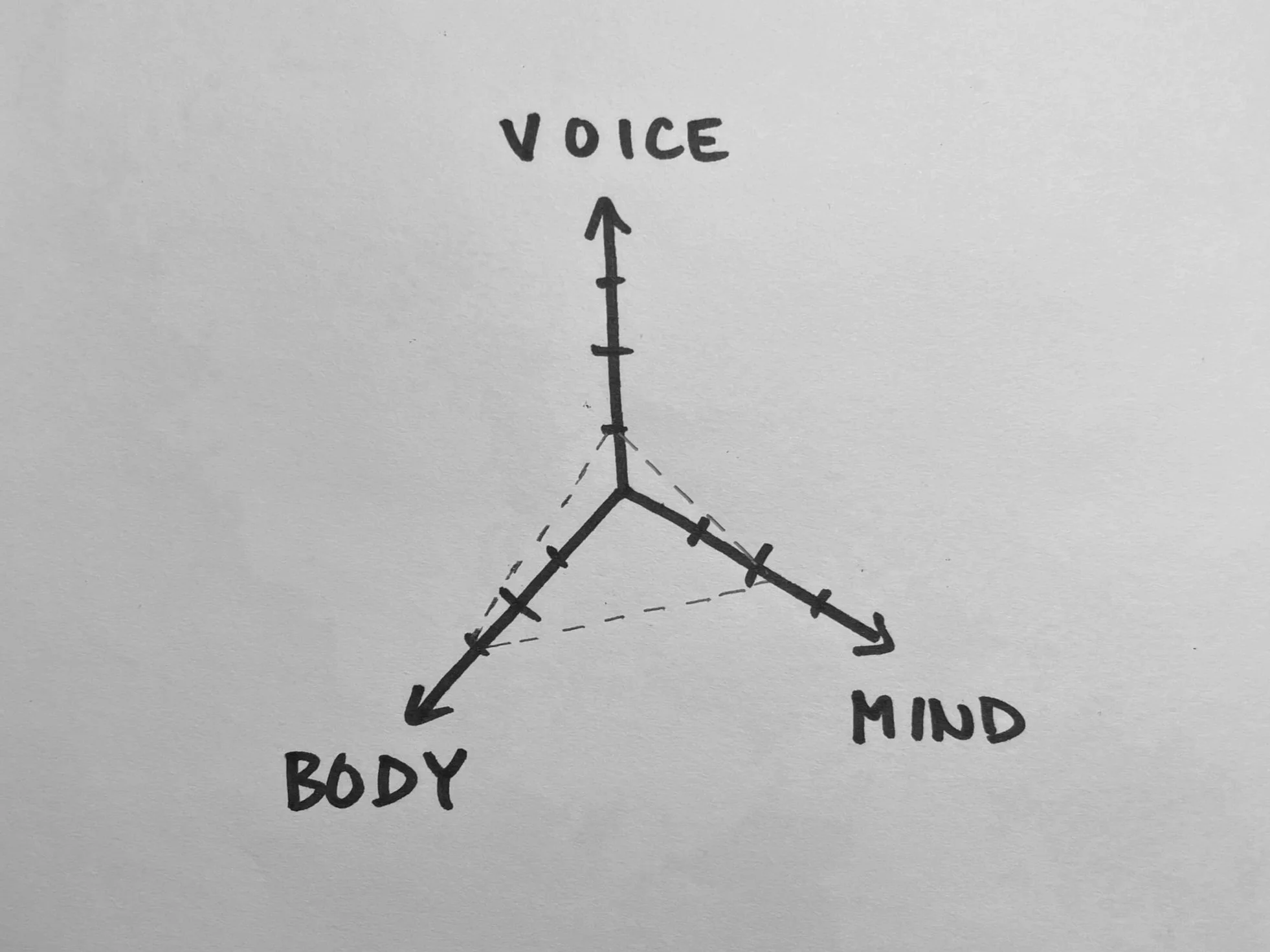
Over the years, I’ve come to feel that music is “of” the Body, the Voice, or the Mind. Good music makes us feel more in touch with our humanity and elevates our spirit. It usually appeals to multiple parts of us and makes us feel more connected and complete. But I find particular styles or pieces of music tend to connect more with one or the other areas. Some music makes us want to move and dance, some makes us hum or sing along, and some helps us get lost in the recesses of our thoughts. Here are some typical characteristics:
Music of the Body: Destabilizing (often syncopated) rhythms; steady pulse; repetetive rhythmic/melodic/harmonic/gestures; often simple formal structures. Destabilizes balance, inspires movement.
Music of the Voice: Human voice or instrument(s) emulating the voice is the focus; instruments support/complement the voice/vocal; often melodic, though could be rhythically or texturally focused (rap, scat, kecak); intelligible words/text. Appeals to the heart, inspires emotion.
Music of the Mind: Often instrumental; complex forms. Sparks thinking, inspires ideas.
I’ve spent a lot of time thinking and learning from trial-and-error what inspires people to move. Syncopation and rhythmic patterns which destabilize (such as various claves) tend to inspire bodily destabilization and more three-demensional body movement.
Ironically, sometimes body-oriented music isn’t great for inspiring dancing, at least in a modern dance class context. I have found that solid, rock-and-roll inspired rhythms dont’t tend to motivate dance movement. I consider them to be heavily body focused, but the rhythmic stablility and strong grounding/reinforcement of the pulse (think of the “Kick-Snare Kick-Kick-Snare” rhythm) tends to have a grounding effect and inspire in-place movements like bobbing, swaying, bouncing, head nodding. All interesting movements, but in modern class inspiring horizontal movement through space is important. Of course, when choosing music for a dance piece, a rock-and-roll song might just be the perfect musical partner for the choreography and moment.
In dance class, my goal is to motivate people to move their bodies and activate their minds. When composing/designing for choreography, I might venture to appeal to the mind and voice of the audience as well.